
What Does It Mean to Live in Authentic Alignment?
There are moments in life when everything looks fine on paper, but something inside of you knows it isn't.
Maybe you have the career you worked hard for, but you no longer feel excited by it. Maybe you're in a relationship, a city, or a version of your life that once made sense and now feels strangely constricting. Maybe nothing is obviously wrong at all. You just have the persistent feeling that there is something else you are supposed to be doing, becoming, or paying attention to.
I think of that feeling as a signal of misalignment.
Authentic alignment is what happens when the life you are living on the outside begins to reflect who you actually are on the inside. Your choices are connected to your values. Your work makes room for your gifts. Your relationships allow you to be yourself. The way you spend your time bears some resemblance to what you say matters to you.
It doesn't mean every part of your life is perfect. It means your life increasingly feels like yours. And figuring out what is actually yours can be harder than it sounds.
We learn how to build lives before we learn how to listen to ourselves
Most of us are taught how to make a life using external markers. Do well in school. Find a good job. Make enough money. Be responsible. Find a partner. Build a career. Buy the house. Get the promotion. Be successful. None of those things are inherently wrong. Some of them may be exactly what you want.
The problem is that we can become very good at accomplishing things without ever asking whether the things we're accomplishing are aligned with who we are. I know this because I did it. For much of my life, I was very good at following the path in front of me. I built a successful career. I took on more responsibility. I learned how to lead people and navigate complicated organizations. From the outside, there were plenty of reasons to keep going. But eventually, another question became louder:
Is this actually the life I want?
That question can be deeply inconvenient. Because sometimes the answer asks something of us.
Why we can know something isn't right and still not change it
This is where parts work changed the way I understand alignment. We often talk about being authentic as though somewhere inside of us there is one clear voice saying, This is what I want, and our only job is to be brave enough to listen. My experience is that the inner world is much more complicated than that.
You might have one part that desperately wants to leave your job and another part that is terrified of losing financial security. One part wants to move across the country while another wants to stay close to everything familiar. One part wants to make art, start a business, fall in love, travel, rest, or completely reinvent your life, while another immediately produces seventeen excellent reasons why that would be irresponsible.
These parts aren't obstacles to authentic alignment. They're trying to protect you.
A part that keeps you in a career you have outgrown may remember how important achievement became to your sense of worth. A people-pleasing part may have learned that belonging depends on being easy to love. A hyper-responsible part may genuinely believe that if it loosens its grip for even a moment, everything will fall apart.
This is why simply asking, "What do I want?" doesn't always produce a clear answer. There may be a committee answering.
Parts work gives us another possibility. Instead of forcing ourselves to choose between competing voices, we can get curious about them. We can understand what each part is protecting, what it fears, and what it needs. And underneath all of that noise, something else often becomes easier to hear. Your deeper knowing.
Alignment requires more than the rational mind
I am a deeply pragmatic person. I like information. I like frameworks. I like things to make sense. I also believe there are forms of knowing that don't arrive through a spreadsheet. Some of the most important decisions of my life have required both. This is why my approach to authentic alignment draws from psychological tools like Internal Family Systems and coaching, but also from practices that create access to a different kind of information.
Astrology is one of those tools.
I don't use a birth chart as an instruction manual that tells you what you have to do with your life. I think of it more as a map of possibilities. It can illuminate patterns in how you relate, where you seek safety, the kinds of tensions you may repeatedly encounter, the gifts you may be here to develop, and the areas of life asking for your attention. Sometimes seeing something reflected in a chart gives language to something you have felt for years but couldn't quite name.
Tarot can work differently. Rather than telling you your future, a card can disrupt the way you're currently thinking about a problem. It gives the intuitive mind something to respond to. You notice what attracts you, what irritates you, what scares you, and what you immediately know when you see the image in front of you.
Shamanic journeying can take that exploration even deeper. By stepping outside our ordinary analytical consciousness, we create space for images, symbols, guides, memories, and insights to emerge. Whether you understand those experiences spiritually, psychologically, or somewhere in between, they can reveal information that the thinking mind has been unable to access. I don't see these practices as replacements for discernment. I see them as ways of expanding it.
You don't have to become someone else
One of the biggest misconceptions about personal transformation is that the goal is to become a better version of yourself. More successful. More spiritual. More confident. More disciplined. More healed. Authentic alignment asks a different question:
What if the work is less about becoming someone new and more about uncovering who is already there?
There are layers between us and that person. There are expectations we inherited. Identities we built because they kept us safe. Definitions of success we absorbed without consciously choosing them. Relationships we've outgrown. Dreams we abandoned because they didn't seem practical. Parts of ourselves we decided were too much, too strange, too ambitious, too sensitive, too mystical, or simply inconvenient. Alignment is the process of becoming curious about all of it.
What is actually mine? What did I inherit? What am I doing because I want to do it? What am I doing because a part of me is afraid of what would happen if I stopped? What have I known for a long time but haven't wanted to admit?
These aren't questions you answer once. They're questions you build a relationship with.
What does an aligned life actually look like?
There is no universal picture of an aligned life.
For one person, alignment might mean leaving a prestigious career. For another, it might mean finally allowing themselves to want the promotion. It might mean starting a business or closing one. Getting married or leaving a relationship. Having children or deciding not to. Moving across the world or putting down roots for the first time. Making more money. Working less. Becoming more visible. Becoming more private. Taking your creative work seriously. Developing your intuitive gifts. Choosing stability after years of adventure. Choosing adventure after years of stability.
The external choice isn't what makes something aligned. The relationship between the choice and you is. That is why authentic alignment requires us to know ourselves deeply enough that we can distinguish between what looks good and what feels true.
The building blocks of authentic alignment
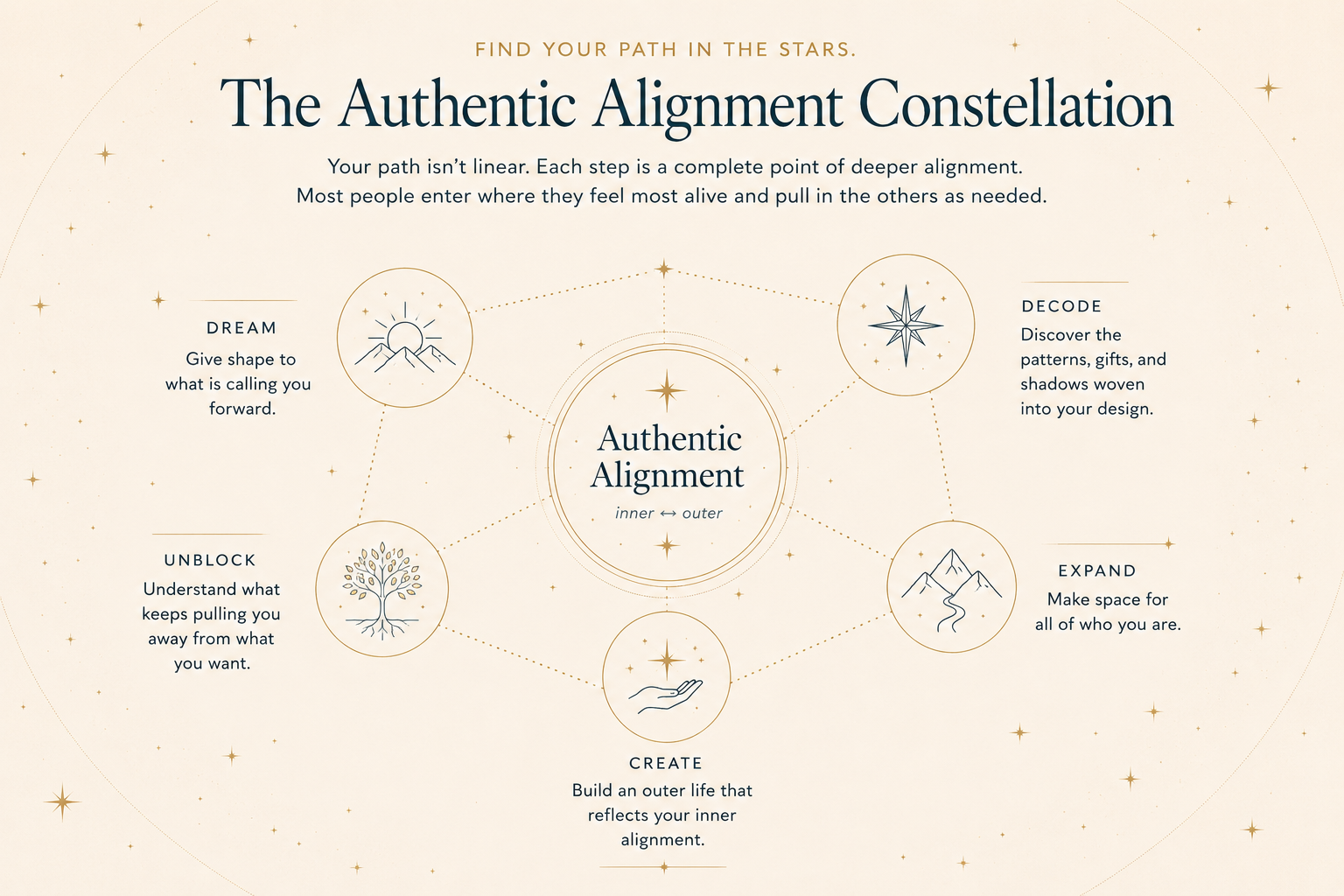
There are a few places I return to again and again when I'm working with someone who knows something needs to change but isn't yet sure what. Over time, I've come to think of them as points in a constellation. They aren't necessarily linear steps. You might enter through whichever one feels most alive, and find that working with one naturally illuminates the others.
Dream. Give shape to what is calling you forward. This is where we make space for desire before worrying about whether it's practical. What do you actually want? What makes you feel alive? What are you curious about, drawn toward, or secretly imagining? We might explore your passions, your purpose, your core values, or simply what a genuinely good life would look and feel like to you.
Decode. Discover the patterns, gifts, and shadows woven into your design. Once we have a sense of what is calling you, we get curious about you. What comes naturally to you? What patterns keep repeating? What have you been taught to value, and what is actually yours? This is where tools like astrology, parts work, tarot, and other forms of self-inquiry can help us see ourselves from angles we might not have considered before.
Unblock. Understand what keeps pulling you away from what you want. Knowing what you want doesn't mean every part of you is ready to go there. A part may be afraid of disappointing people, losing security, being seen, failing, or even succeeding. Instead of treating those fears as self-sabotage, we get curious about what they are protecting and what they might need in order to loosen their grip.
Expand. Make space for all of who you are. Alignment isn't only about removing obstacles. Sometimes it's about reclaiming qualities, desires, identities, or ways of knowing that haven't had enough room in your life. You might be both ambitious and deeply spiritual. Practical and intuitive. Someone who wants stability and adventure. Expansion means becoming big enough to hold more of your own complexity rather than deciding which version of you gets to exist.
Create. Build an outer life that reflects your inner alignment. Eventually, all of this inner exploration has to touch your actual life. The insight becomes a decision. The knowing becomes a boundary. The longing becomes a direction. You experiment, make choices, and begin shaping your work, relationships, routines, environment, and priorities around what you now know to be true.
These aren't abstract exercises, and you don't have to complete one before moving to the next. They inform each other. Dreaming reveals what you want. Decoding helps you understand yourself. Unblocking creates movement. Expanding makes room for more of you. Creating brings it into the world. Together, they become a compass for authentic alignment, helping your outer life move more and more in the same direction as your inner truth.
Alignment isn't a destination
I don't think you arrive at authentic alignment and stay there forever. We change. Our values deepen. New passions emerge. Relationships evolve. Careers that once fit stop fitting. Experiences open parts of us that we didn't previously know existed. Sometimes we outgrow the very life we worked incredibly hard to create. That doesn't mean we chose incorrectly. It means we're alive.
The practice is noticing when the gap between your inner world and your outer life has grown too wide. Sometimes that gap whispers. You feel bored. Restless. Envious of people doing something you secretly want to do. You keep imagining another version of your life. Sometimes it screams. Burnout. A breakup. A job loss. A move. A profound spiritual experience. The sudden realization that you cannot keep living the way you have been living.
Either way, something is asking for your attention.
Learning to trust what you know
For many of us, the hardest part of authentic alignment isn't discovering what we want. It's trusting it. We want more evidence. Another sign. Another tarot card. Another astrology reading. Another person telling us we're making the right decision. Sometimes those tools can help us hear ourselves. But eventually, the work is to build enough relationship with yourself that you can recognize your own knowing. You can notice the frightened parts without automatically letting them drive. You can listen to intuition without abandoning discernment. You can use astrology, tarot, journeying, coaching, and other practices as mirrors without handing your authority over to them. You can take the mysterious information seriously while still keeping your feet firmly planted on the ground.
That, to me, is authentic alignment.
It is not blindly following every impulse or blowing up your life in pursuit of some imagined "true self." It is the ongoing practice of listening deeply, discerning carefully, and having the courage to let the life you're building become a more honest expression of who you are.
And sometimes the first step is simply admitting that the life you have and the life you want are no longer quite the same. Then deciding what you will do about it…
